

Tesla Accidentally Built One of the Most Practical Road-Trip Sleepers of the EV Era
When Tesla first introduced the Model Y, most buyers focused on the obvious things.
Range.
Acceleration.
Charging infrastructure.
Software.
Minimalist design.
Very few people initially imagined the vehicle becoming part of a rapidly growing car-camping movement. Yet several years later, Tesla communities are now filled with owners discussing mattress fitment, sleeping platforms, climate-control efficiency, rear-seat folding geometry, cabin insulation, and overnight charging stops with the seriousness once reserved for traditional RV enthusiasts.
The transformation happened gradually.
At first, owners simply noticed how unusually quiet the cabin felt during long-distance travel. Then people realized Tesla’s Camp Mode effectively turned the vehicle into a climate-controlled sleeping environment capable of maintaining airflow, temperature, lighting, and device charging throughout the night. Add the expansive panoramic roof, flat rear cargo space, and rapidly expanding Supercharger network, and the Model Y began evolving into something no traditional SUV fully anticipated becoming:
A modern digital road-trip capsule.
The arrival of the refreshed 2026 Model Y Juniper accelerated this trend further.
Tesla refined cabin acoustics, improved suspension comfort, upgraded material quality, and made the interior feel more mature overall. For camping-focused owners, these changes mattered enormously because sleeping inside a vehicle amplifies every weakness. Noise becomes more noticeable. Uneven seat geometry becomes uncomfortable quickly. Cabin airflow matters more. Material quality suddenly affects whether the environment feels relaxing or claustrophobic.
The result is that many owners now evaluate the Model Y not simply as transportation, but as a hybrid space somewhere between vehicle, hotel room, lounge, and mobile technology hub.
And surprisingly, the 7-seater version sits at the center of some of the most fascinating debates inside Tesla camping culture.
The 7-Seater Configuration Solves One Problem While Creating Another
On paper, the 7-seat Model Y appears like the ultimate family-friendly EV solution.
Extra seating flexibility.
Better passenger capacity.
Occasional third-row usability.
Road-trip practicality.
But once owners begin exploring camping setups, the conversation becomes more complicated.
The challenge revolves around floor flatness.
In the standard 5-seat Model Y, folding the rear seats creates a relatively usable sleeping platform. It is not perfectly flat, but it remains manageable for many camping setups, especially when combined with foam toppers or inflatable mattresses. The 7-seat configuration introduces additional rear hardware and slightly different seat geometry, creating uneven surfaces that become far more noticeable during overnight sleeping.
This issue sounds minor until people actually attempt spending entire nights inside the vehicle.
Suddenly, small elevation differences feel enormous.
Owners begin experimenting with plywood platforms, foam leveling systems, cargo organizers, inflatable supports, and custom sleeping platforms attempting to create a truly flat sleeping area. Entire online discussions now revolve around measurements, rear-seat angles, and how different mattress systems interact with the Juniper’s updated interior layout.
What makes this trend fascinating is that Tesla owners approach these problems less like traditional campers and more like technology optimizers. They are not simply improvising sleeping arrangements. They are refining systems.
That mindset explains why purpose-built inflatable mattresses designed specifically around the Model Y have become increasingly popular among long-distance travelers and Tesla camping enthusiasts.
Why Inflatable Tesla Mattresses Quietly Became One of the Most Important EV Camping Accessories
Traditional camping mattresses often fail inside EVs for a simple reason:
Cars are not rectangular.
Wheel arches interrupt sleeping space.
Seat transitions create uneven surfaces.
Cargo floors taper toward the rear hatch.
Interior dimensions vary dramatically between models.
Generic camping pads rarely fit cleanly.
Tesla-specific inflatable mattresses changed that by treating the cabin itself as part of the sleeping system rather than merely a container for camping gear.
| Traditional Camping Setup | Tesla-Specific Mattress Setup |
|---|---|
| Generic foam pad | Vehicle-shaped fitment |
| Uneven sleeping surface | Gap-filling support |
| Manual layering adjustments | Simplified deployment |
| Limited side support | Full-width sleeping platform |
| More storage bulk | Compact inflatable storage |
The difference becomes especially important in the 7-seat Model Y because the interior geometry demands more precise support around seat gaps and floor variations.
Many owners initially attempt DIY sleeping solutions before eventually transitioning toward integrated inflatable systems specifically engineered for Tesla interiors. Products from brands like Wigoo increasingly stand out because owners want mattresses designed around exact Tesla cabin dimensions rather than universal camping products adapted awkwardly to automotive spaces.
The emphasis is not purely comfort.
It is efficiency.
Tesla owners tend to value systems that deploy quickly, integrate cleanly, and preserve the minimalist atmosphere of the cabin itself. Poorly fitting camping setups disrupt the very thing many drivers enjoy most about Tesla road trips: simplicity.
Camp Mode Quietly Changed What People Expect From Road Travel
One reason Tesla camping culture expanded so rapidly is that Camp Mode fundamentally alters the emotional experience of sleeping inside a vehicle.
Traditional car camping historically involved compromise.
Temperature fluctuated constantly.
Ventilation remained inconsistent.
Noise insulation felt poor.
Battery anxiety limited device charging.
Sleeping arrangements often felt temporary and improvised.
Tesla changed much of that dynamic.
Owners can now maintain stable cabin temperatures throughout the night without idling a gasoline engine. USB charging remains available continuously. Air circulation stays active. Lighting feels soft and controlled. The panoramic roof creates an unusually open atmosphere during nighttime travel.
These details may sound small individually, but together they transform the psychological experience of vehicle sleeping.
The cabin begins feeling less like a car and more like a compact living environment.
That transition helps explain why younger EV owners increasingly embrace road-trip culture differently than previous generations. Many travelers no longer seek purely rugged outdoor experiences. Instead, they seek mobility combined with comfort, digital connectivity, and environmental simplicity.
Tesla sits unusually well inside that lifestyle shift.
And the Juniper refresh improved several areas directly affecting overnight usability.
Cabin insulation feels quieter.
Suspension tuning reduces travel fatigue.
Interior lighting feels softer.
Climate systems operate more smoothly.
The result is that long-distance travel inside the refreshed Model Y increasingly resembles premium lounge travel rather than traditional automotive road-tripping.
Tesla Camping Reveals How EVs Are Quietly Changing Consumer Behavior
Perhaps the most interesting part of Tesla camping culture is how completely it blurs traditional boundaries between automotive ownership and lifestyle technology.
Previous generations often viewed vehicles primarily as transportation tools. Road trips were temporary experiences disconnected from daily digital life. Camping itself often emphasized disconnection and ruggedness.
Tesla owners increasingly seek something different.
They want flexibility without sacrificing comfort.
Mobility without abandoning connectivity.
Adventure without excessive friction.
The Model Y fits this mentality unusually well because the vehicle behaves more like a rolling software environment than a conventional SUV. Drivers navigate entirely through digital systems. Climate controls operate continuously through software. Entertainment, navigation, charging infrastructure, and route planning integrate seamlessly into one ecosystem.
Sleeping inside the vehicle becomes a surprisingly natural extension of that experience.
This also explains why accessory purchasing behavior among Tesla owners differs so dramatically from traditional automotive aftermarket culture. Historically, enthusiasts focused heavily on performance modifications, aggressive styling, and mechanical customization.
Tesla owners often prioritize environmental optimization instead.
Roof sunshades.
Mattresses.
Storage systems.
Screen protectors.
Thermal management products.
The goal is not transforming the vehicle into something louder or more aggressive.
The goal is refining the ownership experience itself.
The Future of Road Trips May Look More Like Tesla Camping Than Traditional Travel
The growth of Tesla camping may ultimately signal something much larger happening inside modern transportation culture.
Electric vehicles are changing not only how people drive, but how people think about movement itself.
As charging infrastructure expands, vehicles increasingly become places where people spend meaningful downtime rather than simple transition spaces between destinations. Owners watch movies while charging, answer emails inside parked cabins, sleep during road trips, and organize entire travel routines around digitally connected mobility systems.
That changes consumer expectations permanently.
Vehicles now compete not only on driving dynamics, but on livability.
How quiet is the cabin?
How comfortable is the climate system?
How effectively can the interior function during extended stationary use?
How adaptable is the space for travel, rest, and mobility simultaneously?
The Model Y Juniper appears uniquely positioned inside this transition because Tesla accidentally created one of the most flexible modern travel platforms on the road.
It works as a family SUV.
A commuter vehicle.
A software-driven technology environment.
A road-trip machine.
And increasingly, a minimalist sleeping capsule for a generation redefining what travel actually means.
The irony is that Tesla probably never intended the Model Y to become one of America’s most discussed camping vehicles.
But the combination of quiet electric travel, software integration, flat-fold practicality, and climate-controlled overnight comfort created something surprisingly rare in the automotive industry:
A vehicle that feels genuinely designed for how modern people increasingly want to live, travel, and move through the world.
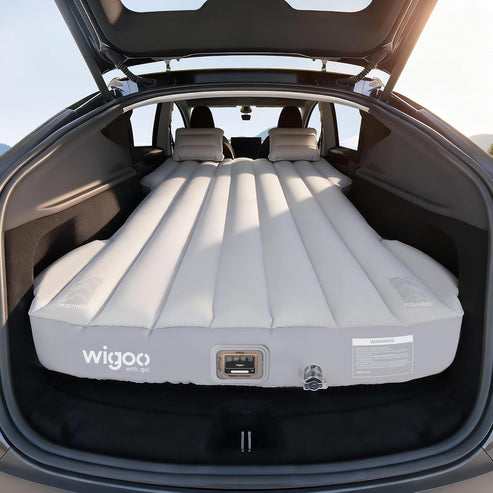
Transform Your Tesla Model Y Into a Luxury Sleeping Space
Designed specifically for the Tesla Model Y 2020–2026, the Wigoo inflatable mattress creates a seamless flat sleeping platform for road trips, camping, and overnight charging stops. Precision-fit edges, integrated support zones, and minimalist styling make it feel like a natural extension of the vehicle itself.
1:1 custom fit for Tesla Model Y
Quick inflation with integrated air pump
Comfortable support for long-distance travel
Compact storage and minimalist design