

For the last half-decade, the Tesla Model Y hasn’t just been a car; it’s been a cultural phenomenon. It’s the suburban gold standard, the vehicle that turned "going electric" from a bold statement into a mundane reality. But as we roll through 2026, the long-awaited "Juniper" refresh has finally hit American driveways.
Tesla fans will tell you it’s a masterpiece of refinement. Critics will argue it’s a masterclass in cost-cutting. After spending a week living with the 2026 Model Y and scouring the front pages of enthusiast hubs like Reddit’s r/ElectricVehicles, the truth lies somewhere in the middle—and it’s a bit more complicated than the fanboys want to admit.
Here is the unfiltered truth about the flaws of the 2026 Tesla Model Y.
1. The "Minimalism" Trap: When Less Is Just... Less
Tesla has always leaned into minimalism, but with the 2026 refresh, they’ve crossed the line from "sleek" to "frustrating."
The Stalkless Struggle
Following in the footsteps of the Model 3 Highland, the Model Y has officially ditched the steering column stalks. To signal a turn, you now press haptic buttons on the wheel. To shift into Drive or Reverse, you swipe on the screen.
In a laboratory, this looks futuristic. In a tight Costco parking lot in New Jersey, it’s a nightmare. Trying to find the turn signal button while the wheel is mid-rotation is a dexterity test no one asked for. As one Redditor aptly put it: "I didn't realize I’d need a PhD in finger-placement just to exit a roundabout."
The HUD-less Void
It’s 2026. Every major competitor—from the Hyundai Ioniq 5 to the Mustang Mach-E—offers a Head-Up Display (HUD) or at least a secondary instrument cluster. Tesla’s stubborn refusal to put vital info in the driver’s line of sight feels less like a design choice and more like a middle finger to traditional ergonomics. Looking center-right to check your speed at 80 mph on the I-95 isn't just annoying; it’s a dated safety compromise.
2. The Glass House Problem: A Greenhouse in a Warming World
The panoramic roof is the Model Y’s calling card, but in 2026, it remains its biggest thermal liability.
Despite Tesla’s claims of improved UV coating, the laws of physics haven't changed. That massive glass pane acts as a thermal sponge. In the Sun Belt—think Texas, Arizona, Florida—the "greenhouse effect" is brutal. Tesla’s Cabin Overheat Protection is constantly battling a losing war, and owners are still reporting "hot head syndrome" where the AC is freezing their feet while the sun is slow-cooking their scalp.
The flaw here isn't just the heat; it's the lack of an OEM solution. Tesla still refuses to offer a built-in power sunshade. Instead, owners are forced to buy third-party mesh inserts that clutter the clean aesthetic they paid for. For a premium vehicle, having to "DIY" your climate control with aftermarket fabric is a glaring oversight.
3. Hardware Hurdles: Living in a 400V World
While the "Juniper" refresh brought a quieter cabin and smoother suspension, the powertrain feels like a relic from 2021.
The Charging Ceiling
We are seeing the rise of 800V architectures across the industry. When you pull up to an Electrify America station in a Kia EV6, you’re in and out in 18 minutes. In the 2026 Model Y, you’re still tethered to a 400V system. While the Supercharger network is still the "Gold Standard" for reliability, the raw speed advantage Tesla once held has evaporated.
The Vision-Only Gamble
Tesla has doubled down on "Vision," removing ultrasonic sensors and radar entirely. In perfect California weather, it’s impressive. But try parking in a rainy Seattle evening or a snowy Chicago morning. The "Vision-Only" park assist is notorious for being twitchy, often yelling "STOP" when you have two feet of clearance, or worse, staying silent when you're inches from a curb. The removal of redundant hardware was a cost-saving win for Tesla, but a functional loss for the driver.
4. Comfort and Ergonomics: The Tall Man’s Burden
The new interior materials in the 2026 model are undeniably nicer to the touch, but the actual geometry of the cabin is starting to feel cramped.
The Left-Foot Crimp: Due to the wheel well and the placement of the "dead pedal," drivers with larger feet report a lack of natural resting space. Over a four-hour drive, this leads to ankle fatigue that you just don't find in a Volvo or an Audi.
Rear Screen Motion Sickness: The new 8-inch rear display is a nice perk for kids, but its placement is so low that adults looking down at it are almost guaranteed to feel nauseous within ten minutes on a winding road.
Seat Bolstering: Tesla updated the seats for "Juniper," but they went a bit too aggressive on the side bolsters for the average American frame. If you aren't built like a marathon runner, you might find the seat base pinching your hips on long hauls.
5. The Reliability "Rattle"
Perhaps the most disappointing flaw discussed in the 2026 forums is the "Juniper Rattle." Despite the marketing talk about improved NVH (Noise, Vibration, and Harshness), early 2026 units are plagued by a persistent suspension clunk.
Reddit’s r/TeslaModelY is currently filled with owners taking their brand-new cars back to Service Centers for control arm replacements and "hollow" sounds coming from the rear hatch. It seems that while Tesla mastered the software, they are still struggling with the basic mechanical consistency of a century-old car manufacturer.
Final Thoughts: The Verdict
The 2026 Tesla Model Y is a victim of its own success. It is so good at being an "appliance" that we’ve started to judge it by a higher standard.
Is it a bad car? Absolutely not. It’s still the most efficient, integrated, and technologically advanced EV for the masses. But the flaws—the missing stalks, the thermal mismanagement, the stubbornness on 400V tech, and the "Vision-only" quirks—are no longer just "quirks." They are genuine compromises.
In 2026, the competition isn't just catching up; in many ergonomic and hardware categories, they’ve already passed. Tesla has built a fantastic computer on wheels, but they’re still learning how to build the "car" part.
Author’s Note for the Wigoo Audience:
If you’ve already taken delivery of a 2026 Model Y and are feeling the heat (literally), don't worry. Most of these flaws have solutions. Whether it's a 7-Layer Thermal Sunshade to fix the greenhouse effect or a Suction-Cup Window Shield that actually stays put when you open the door, the aftermarket is here to finish what Tesla started. Check out our latest 2026 collection to reclaim your cabin comfort.
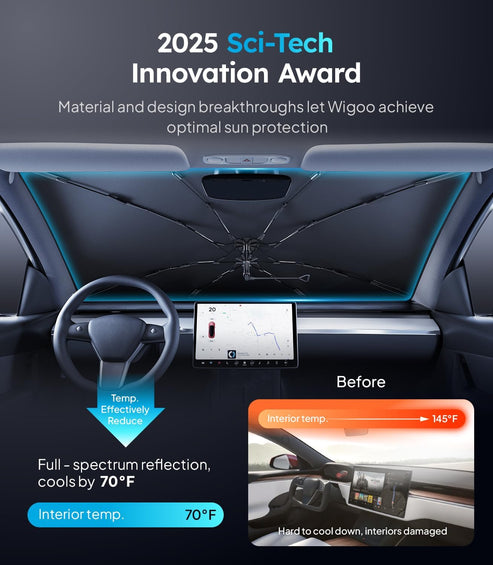
Wigoo Ice-Shield Car Windshield Sun Shade
The only zero-sag solution designed for the 2026 Model Y.
View Product Detail